Search This Blog

Friday, September 16, 2016

CHAPTER TWELVE : INTEGRATING THE ORGANIZATION FROM END-TO-END - ENTERPRISE RESOURCE PLANNING

ENTERPRISE RESOURCE PLANNING (ERP)

When a users update information or data in one module, it is immediately and automatically updated throughout the entire system.

ERP systems automates business processes


BRINGING THE ORGANIZATION TOGETHER

ERP - the organization before ERP


Disadvantages
- Update issues
- Redundancy
- Inaccurate information across database
- Different customer information in different databases
- Different formats of information in the different databases


ERP - bringing the organization together


Disadvantages
- Not as flexible and far more difficult to change because of the standardized information
- Might not meet all department needs as well as an individual specific system 
- Multiple access level increases security issues 
- Ethical dilemmas from accessing different department information


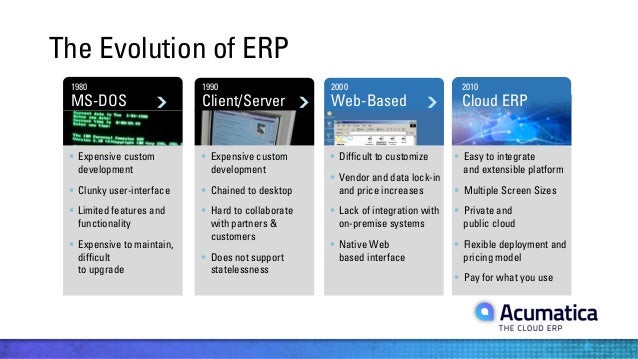
THE EVOLUTION OF ERP


INTEGRATING SCM, CRM, AND ERP


General Audience and Purpose of SCM, ERP, and CRM


INTEGRATING TOOLS

An integrated enterprise infuses support areas, such as finance and human resources, with a strong customer orientation. 

Integration are achieved using:  

Middleware- several different types of software that sit in the middle of and provide connectivity between two or more software applications. It translates information between disparate systems.

Enterprise application integration (EAI) middleware- represents a new approach to middleware by packaging together commonly used functionality, such as providing prbuilt links to popular enterprise applications, which reduces the time necessary to develop solutions that integrate applications from multiple vendors.

Data point where SCM, ERP and CRM integrates.


ENTERPRISE RESOURCE PLANING (ERP)

Flexible- an ERP system should be flexible and quick in order to respond to the changing needs of an enterprise.

Modular and open- an ERP system has to have open system architecture, meaning that any module can be interfaced with or detached whenever required without affecting the other modules. The system should support multiple hardware platforms for organizations that have a heterogeneous collection of systems. It must also support third- party add-on components.

Comprehensive- an ERP system should be able to support a variety of organizational functions and must be suitable for a wide range of business organizations.

Beyond the company- an ERP system must not be confined to organizational boundaries but rather support online connectivity to business partners or customers.


ENTERPRISE RESOURCE PLANNING'S EXPLOSIVE GROWTH

Reasons of ERP being proven to be such a powerful force:

ERP is a logical solution to the mess of incompatible applications that had sprung up in most businesses.

ERP addresses the need for global information sharing and reporting.

ERP is used to avoid the pain and expense of fixing legacy systems


Thursday, September 15, 2016

CHAPTER ELEVEN : BUILDING A CUSTOMER-CENTRIC ORGANIZATION – CUSTOMER RELATIONSHIP MANAGEMENT

CUSTOMER RELATIONSHIP MANAGEMENT (CRM)

CRM enables an organization to;

Provide better customer service
Make call centers more efficient
Cross sell products more effectively
Helps sales staff close deals faster
Simplify marketing and sales processes
Discover new customers
Increase customer revenues

RECENCY, FREQUENCY AND MONETARY VALUE

An organization can find its most valuable customers by using a formula that industry insiders call FRM;
How recently a customer purchased items (recency)
How frequently a customer purchased items (frequency)
How much a customer speeds on each purchased (monetary value)


THE EVALUATION OF CRM

CRM reporting technologies help organizations identify their customers across other applications. CRM analysis technologies help organizations segment their customers into categories such as best and worst customers. CRM predicting technologies help organizations predict customer behavior, such as which customers are at risk of leaving. 


THE UGLY SIDE OF CRM: WHY CRM MATTERS MORE NOW THAN EVER BEFORE


USING ANALYTICAL CRM TO ENHANCE DECISION

Operational CRM – supports traditional transactional processing for day-to-day front-office operations or systems that deal directly with the customers. For example, Sales, Marketing and Customer Service departments.

Analytical CRM – supports back-office operations and strategic analysis and includes all system that do not deal directly with the customers. For example, Financial and Human Resource Department.


CUSTOMER RELATIONSHIP MANAGEMENT SUCCESS FACTORS

CRM success factors include;

Clearly communicate the CRM strategy
Define information needs and flows
Build an integrated view of the customer
Implement in iterations
Scalability for organizational growth


USING ANALYTICAL CRM TO ENHANCE DECISION

Operational CRM and analytical CRM


CHAPTER TEN : ENABLING THE ORGANIZATION - SUPPLY CHAIN MANAGEMENT

BASICS OF SUPPLY CHAIN

SCM – the management of information flows between and among stages in a supply chain to maximize total supply chain effectiveness and profitability

The supply chain has three main links.
1.       Materials flows from suppliers and their upstream suppliers at all levels
2.       Transformation of materials into semi-finished products, or the organization’s own production processes
3.       Distribution of products to customers and their downstream customers at all levels


INFORMATION TECHNOLOGY’S ROLE IN THE SUPPLY CHAIN

 Information technology’s primary role in SCM is creating the integrations or tight process and information linkages between functions within a firm such as marketing, sales, finance, manufacturing, and distribution – and between firms, which allow the smooth, synchronized flow of both information and product between customers, suppliers and transportation providers across the supply chain


VISIBILITY 

Visibility – more visible model of different ways to do things in the supply chain emerged.

·         Supply Chain Visibility is the ability to view all areas up and down the supply chain. Changing supply chains requires a comprehensive strategy buoyed by information technology. Organizations can use technology tools that help them integrate upstream and downstream, with both customers and suppliers.

·         The bullwhip effect occurs when distorted product demand information passes from one entity to the next throughout the supply chain.

CUSTOMER BEHAVIOR

·         The behavior of customers has changed the way businesses complete. Customers will leave if a company does not continually meet their expectations. They are more demanding because they have information readily available, they know exactly what they want, and they know when and how they want it.

·         Demand planning software generates demand forecasts using statistical tools and forecasting techniques. Companies can respond faster and more effectively to consumer demands through supply chain enhancements such as demand planning software.

·         Once an organization understands customer demand and its effect on the supply chain it can begin to estimate the impact that its supply chain will have on its customers and ultimately the organization’s performance.


COMPETITION

·         Supply chain planning (SCP) software uses advanced mathematical algorithms to improve the flow and efficiency of the supply chain while reducing inventory. SCP depends entirely on information for its accuracy.

·         Supply chain execution (SCE) software automates the different steps and stages of the supply chain. This could be as simple as electronically routing orders from a manufacturer to a supplier.


SPEED 

·         These systems raise the accuracy, frequency and speed of communication between suppliers and customers, as well as between internal users.

·         Another aspect of speed is the company’s ability to satisfy continually changing customer requirements efficiently, accurately and quickly.


SUPPLY CHAIN MANAGEMENT SUCCESS FACTORS

·         To succeed in today’s competitive markets, companies must align their supply chain with the demands of the markets they serve.

·         Supply chain performance is now a distinct competitive advantage for companies proficient in the SCM area.


MAKE THE SALE TO SUPPLIERS

The hardest part of any SCM system is its complexity because a large part of the system extends beyond the company’s walls. Not only will the people in the organization need to change the way they work, but also the people from each supplier that is added to the network must change. Be sure suppliers are on board with the benefits that the SCM system will provide.

WEAN EMPLOYEES OFF TRADITIONAL BUSINESS PRACTICES

Operations people typically deal with phone calls, faxes and orders scrawled on paper and will most likely want to keep it that way. Unfortunately, an organization cannot disconnect the telephones and fax machines just because it is implementing a supply chain management system. If the organization cannot convince people that using the software will be worth their time, they will easily find ways to work around it, which will quickly decrease the changes of success for the SCM system.

ENSURE THE SCM SYSTEM SUPPORTS THE ORGANIZATION GOALS

It is important to select SCM software that gives organizations an advantage in the areas most crucial to their business success. If the organizational goals support highly efficient strategies, be sure the supply chain design has the same goals.

DEPLOY IN INCREMENTAL PHASE AND MEASURE AND COMMUNICATE SUCCESS

Design the development of the SCM system in incremental phases. For instance, instead of installing a complete supply chain management system across the company and all suppliers at once, start by getting it working with a few key suppliers, and then move on to the other suppliers. Along the way, make sure each step is adding value through improvements in the supply chain’s performance. While a big-picture perspective is vital to SCM success, the incremental approach means the SCM system should be implemented in digestible bites and also measured for success one step at a time.

BE FUTURE ORIENTED 

The supply chain design must anticipate the future state of the business. Because the SCM system likely will last for many more years than originally planned, managers need to explore how flexible the systems will be when (not if) changes are required in the future. The key is to be certain that the software will meet future needs, not only current needs. 


CHAPTER NINE : ENABLING THE ORGANIZATION - DECISION MAKING

DECISION MAKING

Reasons for Growth of Decision Making Information System

-          People need to analyze large amounts of information – Improvements in technology itself, innovations in communication, and globalization have resulted in a dramatic increase in the alternatives and dimensions people need to consider when making a decision or appraising an opportunity

-          People must make decisions quickly – Time is of the essence and people simply do not have time to sift through all the information manually

-          People must apply sophisticated analysis techniques, such as modeling and forecasting, to  make good decisions – Information systems substantially reduce the time required to perform these sophisticated analysis techniques

-          People must protect the corporate asset of organizational information – Information systems offer the security required to ensure organizational information remains safe.

Model – A simplified representation or abstraction of reality

IT systems in an enterprise


TRANSACTION PROCESSING SYSTEM

Moving up through the organizational pyramid users move from requiring transactional information to analytical information


Transaction processing system – the basic business system that serves the operational level (analysis) in an organization

Online transaction processing (OLTP) – the capturing of transaction and event information using technology to (1) process the information according to defined business rules, (2) store the information, (3) update existing information to reflect the new information

Online analytical processing (OLAP) – the manipulation of information to create business intelligence in support of strategic decision making


DECISION SUPPORT SYSTEMS

Decision support system (DSS) – models information to support managers and business professionals during the decision-making process

Three quantitative models used by DSSs include;

1.       Sensitivity analysis – the study of the impact that changes in one (or more) parts of the model have on other parts of the model

2.       What-if analysis – checks the impact of a change in an assumption on the proposed solution

3.       Goal-seeking analysis – finds the inputs necessary to achieve a goal such as a desired level of outputs

What-if analysis


Goal-seeking analysis


EXECUTIVE INFORMATION SYSTEM

Executive information system (EIS) – A specialized DSS that supports senior level executives within the organization

Most EISs offering the following capabilities;
-          Consolidation – involves the aggregation of information and features simple roll-ups to complex groupings of interrelated information
-          Drill-down – enables users to get details, and details of information
-          Slice-and-dice – looks at information from different perspectives

Interaction between a TPS and an EIS


Interaction between a TPS and a DSS


Digital dashboard – integrates information from multiple components and presents it in a united display


ARTIFICIAL INTELLIGENCE (AI)

The ultimate goal of AI is the ability to build a system that can mimic human intelligence

Intelligent system – various commercial applications of artificial intelligence

Artificial intelligence (AI) – simulates human intelligence such as the ability to reason and learn
- Four most common categories of AI include;
1.       Expert system – computerized advisory programs that imitate the reasoning processes of experts in solving difficult problems

2.       Neural network – attempts to emulate the way the human brain works
o   Fuzzy logic – a mathematical method of handling imprecise or subjective information

3.       Genetic algorithm – an artificial intelligent system that mimics the evolutionary, survival-of-the-fittest process to generate increasingly better solutions to a problem

4.       Intelligent agent – special-purposed knowledge-based information system that accomplishes specific tasks on behalf of its users

DATA MINING

Data-mining software includes many forms of AI such as neutral networks and expert systems


I)                    Cluster Analysis – a technique used to divide an information set into mutually exclusive groups such that the members of each group are as close together as possible to one another and the different groups are as far apart as possible. CRM depends on his system by segment customer info’s and identity behavioral traits.

II)                  Association Detection – reveals the degree to which variables are related and the nature and frequency of these relationship in the information.

Market basket analysis : analysis such items as Websites and the checkout scanner information to detect customers buying behavior  and predict future behavior by identifying affinities among the customers choices of products and services.

III)                Statistical Analysis – performs such functions as information correlations, distribution, calculation and variance analysis.
-          Forecast : predicts made on the basis time series information

-          Time series information : time stamped information collected at a particular frequency.

CHAPTER EIGHT : ACCESSING ORGANIZATIONAL INFORMATION - DATA WAREHOUSE

DATA WAREHOUSE FUNDAMENTALS

Data warehouse – A logical collection of information – gathered from many different operational databases – that supports business analysis activities and decision-making takes

The primary purpose of a data warehouse is to combined information throughout an organization into a single repository for decision-making purposes – data warehouse support only analytical processing

Extraction, transformation and loading (ETL) – A process that extracts information from internal and external databases, transforms the information using a common set of enterprise definitions, and loads the information into a data warehouse.

Data warehouse then send subsets of the information to data mart.

Data mart – contains a subset of data warehouse information.


MULTIDIMENSIONAL ANALYSIS AND DATA MINING

Relational Database contains information in a series of two-dimensional tables.

In a data warehouse and data mart, information is multidimensional, it contains layers of columns and rows
-          Dimension – A particular attribute of information
Cube – common term for the representation of multidimensional information


Data Mining – the process of analyzing data to extract information not offered by the raw data alone.
Also known as “knowledge discovery” – computer-assisted tools and techniques for sifting through and analyzing vast data stores in order to finds trends, patterns and correlations that can guide decision making and increase understanding

To perform data mining users need data-mining tools
-          Data-mining tool – uses a variety of techniques to finds patterns and relationships in large volumes of information. Eg: retailers and use knowledge of these patterns to improve the placement of items in the layout of a mail-order catalog page or Web page.

INFORMATION CLEANSING OR SCRUBBING

An organization must maintain high-quality data in the data warehouse

Information cleansing or scrubbing – A process that weeds out and fixes or discards inconsistent, incorrect or incomplete information

Occurs during ETL process and second on the information once if it is in the data warehouse

Contact information in an operational system


Standardizing Customer  name from Operational Systems


Information cleansing activities
-          Missing Records or Attributes
-          Redundant Records
-          Missing Keys or Other Required Data
-          Erroneous Relationships or References
-          Inaccurate Data


Accurate and complete information


BUSINESS INTELLIGENCE

Business Intelligence – refers to applications and technologies that are used to gather, provides access, analyze data and information to support decision making efforts


These systems will illustrate business intelligence in the areas of customer profiling, customer support, market research, market segmentation, product profitability, statistical analysis, and inventory and distribution analysis to name a few